
You want accuracy, durability, and a straight edge that fits the job. In 2026, the best options range from compact shop tools to long saw guides, but the right choice depends on precision, length, and material.
POWERTEC, Kreg, and Taylor Toolworks each offer strong contenders, and the differences matter more than you would expect.



More Details on Our Top Picks
POWERTEC 24 Inch Aluminum Straight Edge (72330)
The POWERTEC 24 Inch Aluminum Straight Edge (72330) is a smart choice if you need a precision reference tool that stays accurate across its full 24 inch length with a strict .001 tolerance. You can use it to check table tops, engine blocks, cylinder heads, and other work surfaces with confidence. Its true parallel milled edges help you mark, scribe, and align accurately. The lightweight anodized aluminum body resists wear and corrosion, while ribbed reinforcement adds strength and stability. At 24 inches long, it stands upright and stores easily thanks to its hanging hole.
- Length:24 in
- Material:Aluminum
- Flatness Check:Yes
- Hanging Hole:Yes
- Precision Tolerance:.001
- Gripping Profile:Ribbed
- Additional Feature:True parallel milled edges
- Additional Feature:Ribbed reinforcement design
- Additional Feature:Stands upright self-supporting
POWERTEC 50 Inch Aluminum Straight Edge (71503)
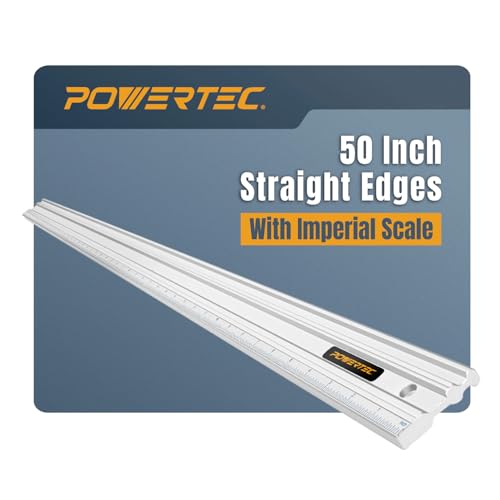
When you need a reliable straight edge for precise layout, flatness checks, or machine calibration, POWERTEC’s 50 Inch Aluminum Straight Edge (71503) is a solid choice. Use it to spot warp, verify accuracy, center items, and scribe clean lines. Its thick, ergonomic profile and ribbed reinforcement provide a confident grip, while the smooth reference edge stays true. Lightweight anodized aluminum resists wear, and the hanging hole makes storage simple. At 50 inches long, with .003″ tolerance, it is well suited for woodworking, concrete finishing, drafting, automotive feeler gauge checks, and shop machinery.
- Length:50 in
- Material:Anodized aluminum
- Flatness Check:Yes
- Hanging Hole:Yes
- Precision Tolerance:.003
- Gripping Profile:Ribbed
- Additional Feature:5/16-inch measuring surface
- Additional Feature:Smooth flat reference edge
- Additional Feature:Single hanging hole
POWERTEC 38 Inch Machinist Aluminum Straight Edge (71332)
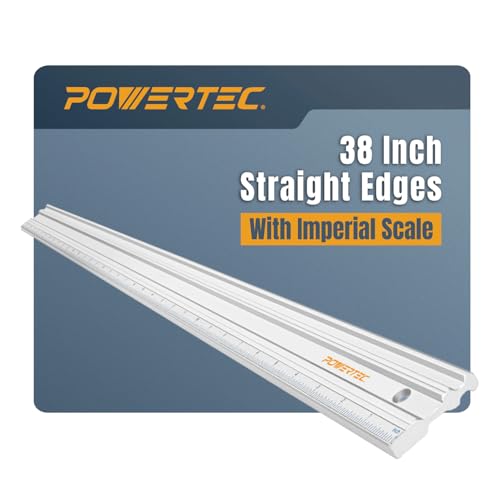
POWERTEC’s 38-inch machinist aluminum straight edge is a strong choice for anyone who needs accurate flatness checks, from mechanics verifying engine block or cylinder head surfaces to woodworkers aligning jointers and planers. It offers precision-machined accuracy to 0.003 inch, true parallel edges, and dual-sided metric and standard graduations. The anodized aluminum body resists wear, rust, and bending, while the ribbed, thick profile feels solid in hand. Use it with feeler gauges, or as a scribing, drafting, or marking guide. It is easy to store, too.
- Length:38 in
- Material:Anodized aluminum
- Flatness Check:Yes
- Hanging Hole:Yes
- Precision Tolerance:.003
- Gripping Profile:Ribbed
- Additional Feature:Dual metric-standard ruler
- Additional Feature:1/16-inch graduations
- Additional Feature:Self-supporting hands-free use
Kreg KMA4700-E Straight Edge Guide XL 98-Inch
Kreg’s KMA4700-E Straight Edge Guide XL is a smart choice for woodworkers and carpenters who want cleaner, more accurate cuts with a circular saw. It also works with jig saws and trim routers, so you are not limited to one tool. The 98-inch aluminum rails help you maintain a precise line for cross cuts and rip cuts, while the cutline indicator simplifies setup. It is compatible with right-handed and left-handed saws, and the anti-slip clamp keeps the guide secure on materials up to 8 feet long for consistent results.
- Length:98 in
- Material:Aluminum rails
- Flatness Check:No
- Hanging Hole:No
- Precision Tolerance:Not listed
- Gripping Profile:Guide rail
- Additional Feature:Edge-guided cutting system
- Additional Feature:Anti-slip clamp
- Additional Feature:Cross-cut and rip cuts
24 Inch Anodized Aluminum Straight Edge SE24
The 24 Inch Anodized Aluminum Straight Edge SE24 is a solid choice when you need a reliable, budget-friendly reference edge for shop setup and flatness checks. Taylor Toolworks machines it straight within 0.001 inch over its full 24-inch length, and the reference edge stays flat within 0.001 inch. You will appreciate the anodized aluminum body, contoured grip, and hanging hole. Its 0.040 inch thickness and 1.750 inch width make handling easy. Use it for machine tables, jointers, planers, and outfeed tables. It is an economical alternative to pricier straight edges, and it is available in three lengths.
- Length:24 in
- Material:Anodized aluminum
- Flatness Check:Yes
- Hanging Hole:Yes
- Precision Tolerance:.001
- Gripping Profile:Contoured
- Additional Feature:0.0400-inch thickness
- Additional Feature:Contoured cross section
- Additional Feature:Economical alternative option
18″ Anodized Aluminum Straight Edge (SE18)
If you need a reliable, budget-friendly reference edge for shop setup, the 18″ anodized aluminum Straight Edge SE18 is a solid fit. It has a machined-flat, smooth edge that is guaranteed straight within 0.001″ across its full 18″ length. Taylor Toolworks makes it, and the anodized aluminum body keeps it light at 14.1 ounces. The contoured cross section provides a secure grip, and the hanging hole makes storage easy. Use it to check machine table flatness, and to set jointers, planers, and outfeed tables. It is an economical alternative to pricier straight edges, and it is available in four lengths.
- Length:18 in
- Material:Anodized aluminum
- Flatness Check:Yes
- Hanging Hole:Yes
- Precision Tolerance:.001
- Gripping Profile:Contoured
- Additional Feature:7/16-inch thickness
- Additional Feature:Available in four lengths
- Additional Feature:Construction Rulers category
50″ Anodized Aluminum Straight Edge 50″ Length SE50
Taytools’ 50″ anodized aluminum straight edge, model SE50, is a smart pick whenever you need a lightweight, easy to handle reference edge for accurate setup work. It features extruded aircraft aluminum with a black anodized finish, and the machined reference edge stays flat within 0.003″ over its full length. At 50″ long, 1-3/4″ wide, and 7/16″ thick, it offers a comfortable grip for machine table checks, jointer setup, planer setup, and outfeed table alignment. It is also an economical alternative to pricier straight edges, and the hanging hole makes storage simple.
- Length:50 in
- Material:Aircraft aluminum
- Flatness Check:Yes
- Hanging Hole:Yes
- Precision Tolerance:.003
- Gripping Profile:Easy-grip
- Additional Feature:Extruded aircraft aluminum
- Additional Feature:Black anodized finish
- Additional Feature:Available in five lengths
Factors to Consider When Choosing Straight Edges
Whenever you choose a straight edge, consider the material, durability, length, width, and flatness tolerance. You should also look for a comfortable grip and handling that suits your work, along with clear measurement markings when you need a quick reference. These factors help you choose a tool that stays accurate and performs well for your tasks.
Material And Durability
Material matters because it directly affects how well a straight edge holds up and how accurately it works over time. You will often get the best balance from anodized aluminum because it is light, resists abrasion, and does not corrode easily. Choose a solid one piece or extruded body so the tool stays rigid and keeps its accuracy after years of use. A thicker profile, around 5/16 in to 7/16 in, helps reduce flex and improves durability when you use it often. If you want extra strength, look for reinforced ribbing, which adds stability without making the tool awkward. Most important, the reference edge should stay smooth and machined to tight tolerances, around 0.001 in to 0.003 in, even in a busy shop.
Length And Width
After material and durability, length and width become the next big factors in choosing a straight edge. You should match the length to the area you need to inspect, whether that is 18, 24, 38, 50, or 98 inches, so the tool spans the surface without gaps. Longer straight edges work best on large tables, machine beds, and panels, while shorter ones are easier to handle, store, and use on compact surfaces. Width matters too. A wider body, often around 1.75 to 2.25 inches, can feel steadier and easier to grip, and the measuring face is usually about 5/16 inch wide. Choose dimensions that give you coverage and control, so you can position the edge comfortably and check surfaces accurately.
Flatness Tolerance
Flatness tolerance tells you how much a straight edge can deviate from a true straight line across its full length, so smaller numbers mean higher precision. When you need precision layout or inspection work, look for about 0.001 in tolerance. It helps you spot tiny warps and surface defects. A 0.003 in tolerance can still work for general alignment and flatness checks, but it will not reveal subtle errors as well. Always confirm whether the rating covers the entire edge or only part of it, because that changes how you judge accuracy. If you plan to use feeler gauges, choose a tighter tolerance so your readings stay consistent and meaningful. That extra precision gives you more confidence when you compare surfaces and decide whether they are truly flat.
Grip And Handling
For easier handling, choose a straight edge with an ergonomic or contoured profile. Widths around 1.75 to 2.25 inches and thicker bodies from 5/16 inch to 7/16 inch are easier to grip securely. A ribbed or reinforced body helps you keep control, especially when moving a long 24-inch to 50-inch tool. Lightweight aluminum also improves comfort during extended use, while still staying rigid enough for accurate control. If the straight edge stands upright on its own, you can pick it up and set it down faster during repeated checks. A built-in hanging hole makes storage simpler, so you can retrieve it quickly and keep it protected between jobs.
Measurement Markings
Once you’ve chosen a straight edge that feels good in hand, look at the measurement markings next. You’ll want clear graduations if you plan to scribe, draft, or repeat measurements accurately. Dual-scale markings in standard and metric units let you switch systems quickly and reduce conversion mistakes. Finer divisions, such as 1/16 inch marks, improve precision as you check alignment or set out lines. Make sure the markings stay easy to read from end to end, because consistency matters across the full length. If you also use the straight edge as a reference tool, verify that the printed or etched scales do not interrupt the flat edge or compromise accuracy. Clean, legible markings help you work faster and trust every measurement you make.
Intended Applications
Start by matching the straight edge to the job you need to do. When you are checking table flatness, engine block distortion, or cylinder head warpage, choose a precision tool with tight straightness tolerance so you can trust feeler gauge results across the full length. For woodworking setup, pick a length that spans the jointer bed, planer table, or outfeed table, because a short edge can bridge low spots and give a false reading. If you also use it for drafting, marking, or scribing, make sure the edge stays smooth and true while guiding cuts or lines. When you handle it often or store it between jobs, look for a standing design or hanging hole that keeps it organized and easy to grab.
Frequently Asked Questions
What Materials Offer the Best Long-Term Corrosion Resistance?
You’ll get the best long-term corrosion resistance from stainless steel, especially marine-grade alloys, and titanium. If you need a lighter material, choose anodized aluminum. Avoid plain steel unless you can coat and maintain it.
How Often Should a Straight Edge Be Recalibrated or Checked?
You should check your straight edge before each critical use and recalibrate it whenever it has been dropped, stored poorly, or shows wear. For routine work, a monthly check usually keeps you confidently on line.
Can Straight Edges Be Used for Saw Alignment Accuracy?
Yes, you can use a straight edge to check saw alignment, but it should be truly flat and accurate. Verify it against a reliable reference, since even small errors can affect your setup.
What Storage Method Prevents Straight Edge Warping or Damage?
Store it flat on padded hooks or a rack, away from heat and moisture. This helps prevent warping, dents, and dings, and keeps it accurate longer.
Are Straight Edges Suitable for Both Woodworking and Metalworking?
Yes, you can use straight edges for both woodworking and metalworking, but you should choose the right material and level of precision for each task. Use a rigid, durable straight edge that will not flex, nick, or wear quickly.