

If I am choosing a radius gauge in 2026, I want one that is accurate, easy to read, and built to last.
I have found that the right set can save time whether I am checking parts in the shop or matching a guitar’s fretboard and strings.
Some options stand out for stainless steel build quality, while others are designed for quick setup work.
The differences matter more than you might expect, and a few picks could surprise you.
| Accusize 25 Pc Fractional Radius Gauge Set |  | Best Overall | Gauge Count: 25-piece set | Measurement Range: 1/64″–1/2″ | Material: Stainless steel | VIEW LATEST PRICE | Read Our Analysis |
| MusicNomad Precision Fretboard and String Radius Gauge Tool |  | Best For Guitars | Gauge Count: 2-piece set | Measurement Range: 7.25″–20″ | Material: Stainless steel | VIEW LATEST PRICE | Read Our Analysis |
| Glarks Radius Gauge Set Stainless Steel Measuring Tool |  | Best Metric Set | Gauge Count: 4 gauges | Measurement Range: R0.3–25 mm | Material: Steel | VIEW LATEST PRICE | Read Our Analysis |
| Accusize Industrial Tools Radius Gauge Set (26 Pc) | 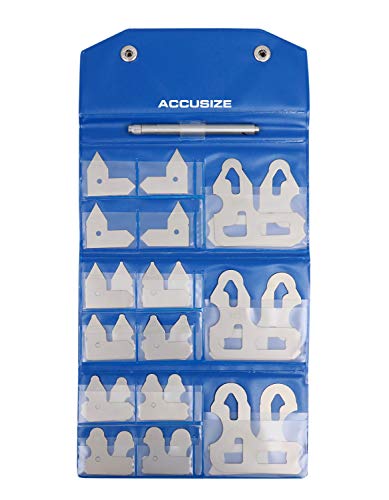 | Most Comprehensive | Gauge Count: 26-piece set | Measurement Range: 0.010″–0.500″ | Material: Rust-proof steel | VIEW LATEST PRICE | Read Our Analysis |
| StewMac Understring Radius Gauges Set of 9 |  | Best Understring | Gauge Count: 9-piece set | Measurement Range: 7.25″–20″ | Material: Metal | VIEW LATEST PRICE | Read Our Analysis |
| 5Pcs Stainless Steel Radius Gauge Set |  | Best Compact Set | Gauge Count: 5-piece set | Measurement Range: R0.3–50 mm | Material: Stainless steel | VIEW LATEST PRICE | Read Our Analysis |
| 25-Piece Radius Gauge Set with Holder (3602-5021) |  | Best Industrial Use | Gauge Count: 25-piece set | Measurement Range: 1/64″–1/2″ | Material: Rust-proof steel | VIEW LATEST PRICE | Read Our Analysis |
More Details on Our Top Picks
Accusize 25 Pc Fractional Radius Gauge Set
Need a reliable fractional set for everyday inspection? Reach for the Accusize 25 Pc Fractional Radius Gauge Set. It includes 25 stainless steel gauges in a satin chrome finish, covering 1/64 to 1/2 inch. You get two ranges, a holder, and a fitted plastic case for easy storage. Each gauge is individually marked, so you can find the right size quickly. Accuracy stays tight across the set, from ±0.0008 to ±0.0014. At 4.9 ounces, it is lightweight, rust proof, and ready for shop or field checks without batteries.
- Gauge Count:25-piece set
- Measurement Range:1/64″–1/2″
- Material:Stainless steel
- Finish:Satin chrome
- Storage:Plastic fitted case
- Markings:Individually marked
- Additional Feature:Fractional inch sizing
- Additional Feature:Includes holder
- Additional Feature:Satin chrome finish
MusicNomad Precision Fretboard and String Radius Gauge Tool
MusicNomad’s Precision Fretboard and String Radius Gauge Tool is ideal if you want accurate guitar setup matching. You get a two piece set that checks fretboard and string radius with dependable accuracy across 7.25″, 9.5″, 10″, 12″, 14″, 15″, 16″, and 20″ sizes. It works for electric, acoustic, and bass guitars, so you can dial in multiple instruments. The black finish improves visibility, while etched instructions remove guesswork. Premium stainless steel, smooth edges, and laser etched markings add durability. It also fits the KISS setup approach, helping you match radii fast.
- Gauge Count:2-piece set
- Measurement Range:7.25″–20″
- Material:Stainless steel
- Finish:Black polished
- Storage:Not specified
- Markings:Laser-etched
- Additional Feature:Fretboard radius matching
- Additional Feature:String radius matching
- Additional Feature:KISS setup method
Glarks Radius Gauge Set Stainless Steel Measuring Tool
Should you need a precise metric radius gauge, Glarks stainless steel set covers a wide range. You get four fillet gauges spanning R0.3 to 1.5 mm, R1 to 6.5 mm, R7 to 14.5 mm, and R15 to 25 mm, so you can match small or large radii quickly. The high quality, heat processed steel has a chrome finish, a smooth polished surface, and anti rust oil for strong corrosion resistance. Clear leaf markings and two leaf types help you identify convex and concave shapes fast. It also comes in a plastic box, making storage and transport easy for machinists and tool makers.
- Gauge Count:4 gauges
- Measurement Range:R0.3–25 mm
- Material:Steel
- Finish:Chrome
- Storage:Plastic box
- Markings:Clearly marked
- Additional Feature:Convex/concave templates
- Additional Feature:Four gauge shapes
- Additional Feature:Tool radius inspection
Accusize Industrial Tools Radius Gauge Set (26 Pc)
Accusize Industrial Tools’ 26-piece set is the most complete choice for precise radius matching. You get model 3602-5025 with a holder, and you can check radii from 0.010″ to 0.500″ quickly. The blades cover 0.010″ to 0.025″ in 0.005″ steps, 0.030″ to 0.100″ in 0.010″ steps, 0.120″ to 0.300″ in 0.020″ steps, and 0.350″ to 0.500″ in 0.050″ steps. Rust-proof steel and a satin chrome finish help it last, while each blade is individually marked. You also store it neatly in the included plastic fitted case.
- Gauge Count:26-piece set
- Measurement Range:0.010″–0.500″
- Material:Rust-proof steel
- Finish:Satin chrome
- Storage:Plastic fitted case
- Markings:Individually marked
- Additional Feature:Fine 0.005 increments
- Additional Feature:0.010-0.500 range
- Additional Feature:Includes holder
StewMac Understring Radius Gauges Set of 9
StewMac’s Understring Radius Gauges provide a fast, reliable way to match fretboard curves. The set includes nine gauges covering 7-1/4, 9-1/2, 10, 12, 14, 15, 16, 17, and 20 inches, giving you the range needed for complete setup work. The standard width fits string spreads up to 2-5/8 inches, making these gauges ideal for 6-string guitars and most 4-string basses. You can read the fretboard radius in place, adjust saddles without removing strings, and align saddle or polepiece height accurately. Built for lifetime use, they are backed by StewMac’s Lifetime Promise and expert support.
- Gauge Count:9-piece set
- Measurement Range:7.25″–20″
- Material:Metal
- Finish:Smooth metal
- Storage:Not specified
- Markings:Not specified
- Additional Feature:Understring measurement design
- Additional Feature:Fits 2-5/8 spreads
- Additional Feature:Lifetime Promise
5Pcs Stainless Steel Radius Gauge Set
This 5 piece stainless steel radius gauge set gives you a compact, portable way to check arcs fast. You get five clearly marked leaves covering R0.3 to 1.5 mm, R1 to 6.5 mm, R7 to 14.5 mm, R15 to 25 mm, and R25 to 50 mm, so you can match small or large radii with confidence. The durable, rust resistant steel and 360 degree locking screw make it easy to unfold and fold without fuss. Use the convex and concave templates to check internal or external curves, plus radius, thickness, and width. It is a solid pick for mechanics, makers, and tool shops.
- Gauge Count:5-piece set
- Measurement Range:R0.3–50 mm
- Material:Stainless steel
- Finish:None specified
- Storage:Not specified
- Markings:Clearly marked
- Additional Feature:360-degree locking screw
- Additional Feature:External internal arcs
- Additional Feature:Portable foldable design
25-Piece Radius Gauge Set with Holder (3602-5021)
The 25 piece 3602-5021 radius gauge set is built for industrial inspection tasks. You can verify radii, fillets, and angles on metal parts in manufacturing, automotive, metalworking, and CNC applications. It measures concave and convex profiles accurately, giving you a reliable standard for comparison. The included holder and protective sleeve keep each gauge organized, easy to access, and safe during transport. Rust proof steel with a satin chrome finish resists wear and corrosion. Precision etched sizes from 1/64″ to 3/8″ help you select the right gauge quickly, while tight tolerances support dependable checks.
- Gauge Count:25-piece set
- Measurement Range:1/64″–1/2″
- Material:Rust-proof steel
- Finish:Satin chrome
- Storage:Protective sleeve/holder
- Markings:Individually marked
- Additional Feature:CNC inspection use
- Additional Feature:Protective sleeve included
- Additional Feature:Angle verification tool
Factors to Consider When Choosing Radius Gauges
When choosing radius gauges, I first look at the measurement range to make sure it covers the curves you work with. I also check gauge accuracy, material durability, and clear markings so you can trust each reading and use the set for a long time. Finally, I consider the set size, since the right mix of blades can make your work faster and easier.
Measurement Range
I look for a radius gauge set whose measurement range covers every radius I expect to inspect, whether that means fractional sizes from 1/64 inch to 1/2 inch or metric sizes from 0.3 mm to 50 mm. I also check how finely the set steps through that span, because small increments such as 0.005 inch, 0.010 inch, 0.020 inch, or 0.050 inch give me more useful choices than broad jumps. When I work on guitars, I want the common fretboard and string radii, including 7.25, 9.5, 10, 12, 14, 15, 16, 17, and 20 inches. For machining, I prefer a wider spread of sizes. I make sure the set handles both concave and convex forms when I need to inspect internal and external arcs across the same range.
Gauge Accuracy
After checking that a radius gauge set covers the sizes you need, I look at accuracy next because a wide range does not help when the tolerances are too loose for the job. I check the stated tolerance first, since many gauges list figures like ±0.0008 in on smaller radii and about ±0.0014 in on larger ones. I also watch for variation across the range because finer sizes often stay tighter than bigger ones. When I compare sets, I make sure the accuracy applies to the full range, not just a few size bands. For inspection and setup work, I choose the higher precision option since small errors can change fit or alignment. For radius checking, I match the tolerance to the precision my task demands.
Material Durability
Material durability matters because a radius gauge can lose accuracy when the leaves corrode, wear, or bend with repeated use. I look for stainless or rust-proof steel because it resists corrosion and stays dependable longer. I also prefer heat-processed or high-hardness steel since it holds up better when I use the set often in a shop. A satin chrome or polished finish helps protect the surface from scratches and everyday abrasion. I pay attention to the case as well. A fitted holder keeps the leaves from getting dinged, bent, or exposed to moisture during storage and travel. When I choose a gauge built this way, I know I can keep using it confidently without replacing it too soon or worrying about avoidable damage.
Marking Clarity
Clear, individually marked leaf sizes help me find the right radius quickly without second-guessing, and laser-etched or precision-etched numbers are easier to read than printed markings. When I am checking a fit, I want markings that stand out, so high-contrast finishes with bright numbers are easier to read against the steel and make contact checks simpler. Fine increment ranges matter too. When I compare radii in 1/64 inch or 0.010 inch steps, I need crisp labels that I can trust at a glance. I also look for tools whose markings stay legible on polished, rust-resistant steel, because that helps keep measurement selection consistent over time. Good clarity saves me time, reduces mistakes, and helps me choose the right gauge confidently on every job.
Set Size
If I choose a radius gauge set, I start by making sure it covers the full range I actually need, whether that is common fractional sizes from 1/64 to 1/2 inch or metric sizes from 0.3 to 50 mm. Bigger sets give me more steps between sizes, so I can match concave or convex curves more accurately. Smaller sets are faster to handle, but they can skip radii I need and leave me guessing. When I am doing guitar setup work, I prefer a multi-piece set with the standard radii I see most often, since fingerboards and strings usually follow a few common curves. I also check that the set includes enough gauges to match both the rough radius and the tolerance I need.
Storage Case
After I’ve picked the right size range, I also look at the storage case because it affects how quickly I can grab the right leaf and how well the gauges hold up over time. I want a fitted case that keeps each gauge organized by size, so I can open it and find the leaf I need without hunting. A protective shell also matters since it helps prevent dings, scratches, and corrosion when I store or carry precision metal gauges. I prefer compact cases with a holder or sleeve because they keep the leaves secure and stop them from shifting, bending, or mixing together. I also like cases that keep the whole set in one place since that makes transport easier and supports long-term accuracy by protecting edges and markings from wear.
Application Fit
For the right application, I match the gauge type to the task first, because a set made for internal and external radii on machined parts will not always fit guitar fretboard or string radius work. I check the measurement range next so I know it covers the radii I actually inspect, whether that is tiny fractional or metric arcs for precision parts or common guitar values like 7.25″, 9.5″, 12″, 14″, 16″, or 20″. I also look for a direct comparison tool that reads both concave and convex surfaces clearly. If I am doing setup work, I choose gauges I can place without disturbing the assembly. For repeated shop use, I prefer clear markings and organized storage so I can grab the right gauge fast.
Frequently Asked Questions
How Do I Calibrate a Radius Gauge?
I calibrate a radius gauge by comparing each leaf to a known reference radius or precision template, then adjusting for any gaps or wear. I clean the gauge, test both sides, and recheck until it matches consistently.
Can Radius Gauges Measure Worn Fretboards Accurately?
I’d say yes, but only approximately. Radius gauges can help identify a worn fretboard’s general curve, but wear, grooves, and uneven frets can affect the reading, so I would confirm the result with straightedges and careful inspection.
Are Digital Radius Gauges Better Than Manual Ones?
I’d say digital radius gauges are not always better. They are faster and easier to read, but I still trust manual ones for feel and simplicity. You will get the best results when you match the gauge to your task.
What Materials Are Best for Long-Lasting Radius Gauges?
I’d choose hardened stainless steel or carbide because they resist wear and corrosion. Stainless can last up to 10 times longer than soft steel in harsh shops, helping keep your radius gauges accurate for years.
How Should I Clean and Store Radius Gauges?
I clean radius gauges with a soft cloth, mild solvent, and light oil, then dry them completely. I store them in a protective case, away from moisture, dust, and temperature changes.