

Plugging into a campground spigot can feel like rolling the dice on your plumbing. City hydrants, well systems, and shared park pressure can swing wildly, and your RV’s thin-walled PEX lines, faucets, and water heater were never built for 100 psi surprises. A solid regulator drops incoming pressure into a safe 40 to 50 psi band, protecting every fitting downstream, while a low-pressure gauge helps you catch a failing regulator before it ruins a trip.
The list below covers four purpose-built RV regulators and six capsule-and-bourdon gauges that pair nicely with one, covering common camping pressures, water-pump testing, and HVAC-style work.
The Choices Worth Comparing

Camco Brass Marine/RV Water Pressure Regulator

Hourleey Brass RV Water Pressure Regulator with Filter

Valterra Lead-Free Brass RV Water Regulator
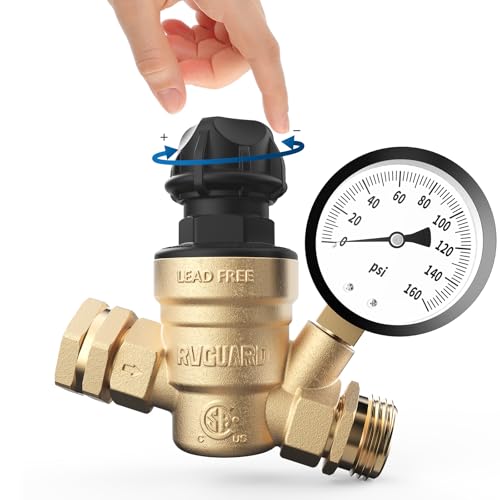
RVGUARD Adjustable RV Water Pressure Regulator Valve

BPSSDI 0–3 PSI Capsule Pressure Gauge

BPSSDI 0–5 PSI Capsule Pressure Gauge

BPSSDI 0–30 PSI Glycerin-Filled Pressure Gauge

BPSSDI 0–30 PSI IP67 Pressure Gauge

BPSSDI 0–100 PSI Pressure Gauge

BPSSDI 0–60 PSI Glycerin-Filled Pressure Gauge
Why These Options Stand Out
Camco’s brass regulator is the kind of part you screw on once and mostly forget. It’s designed to drop incoming city or campground water into a safer band before that pressure ever reaches your RV’s plastic fittings, faucets, or water heater. Owners reaching for it at a crowded Saturday-morning hookup get a heavy, palm-sized body that feels reassuring in the hand.
Because it ships pre-set, there’s no fiddling at the spigot. You connect a standard drinking-water hose, hand-tighten the fitting, and open the valve slowly. The whole install is the kind of thing a first-time RVer can finish in under two minutes with no extra tools.
Advantages To Know
- Solid brass body resists corrosion across many seasons of use.
- Pre-set output keeps plumbing, fittings, and water heater within safe limits.
- Standard 3/4-inch garden-hose threading drops onto common RV hoses.
- Compact size stashes easily in an exterior compartment.
- Safe for potable water lines, so onboard drinking stays worry-free.
Things To Consider
- Pre-set output means you can’t fine-tune pressure for unusual setups.
- Brass adds noticeable weight compared with plastic-bodied units.
Key Specs
Who It Suits Best
Full-time RVers and weekend travelers who want a no-fuss regulator that just works on every campsite without adjusting knobs.
Consider Something Else When
Pick the RVGUARD Adjustable RV Water Pressure Regulator Valve if you need to dial pressure up or down for a specific fixture or a non-standard setup.
The Hourleey regulator targets the same 40 to 50 psi sweet spot as the Camco above, but its real surprise is the stainless steel filter screen sitting at the inlet. Sand, scale, and rust flakes from old park plumbing are the silent killers of RV toilet valves and faucet cartridges, so catching debris before it enters your hose buys you real longevity.
The brass body handles high pressure well, and 3/4-inch threading keeps it compatible with standard campground hardware. The included screen is the kind of small detail that makes a noticeable difference after a dusty desert weekend.
Key Advantages
- Stainless steel inlet filter traps sediment and rust before it travels downstream.
- Brass body holds up to pressure spikes and rough handling.
- Standard hose threading fits the same hoses and fittings you already own.
- Maintains a steady 40 to 50 psi output across fluctuating supply pressure.
Trade Offs
- The screen needs periodic cleaning in areas with heavy sediment.
- Pre-set output leaves no room to tune for unusual fixtures.
Made For
Budget-minded campers who camp across a mix of older parks where gritty water is a real concern.
Look Elsewhere When
Skip to the Valterra Lead-Free Brass RV Water Regulator if lead-free certification and long-term brand reputation matter more than an inlet screen.
Valterra’s regulator carries a simple, old-school design that has earned its place in countless trailer bays. It drops campground pressure into the 40 to 50 psi window that RV plumbing, water heaters, and toilet valves are engineered around. The lead-free brass body is built with drinking water in mind, which matters if you cook or brush teeth from the onboard tank.
Where the Camco leans on brand familiarity and the Hourleey adds a screen, the Valterra sits in the middle. It is the regulator you grab when you want a no-nonsense part from a supplier that has served the RV world for decades.
What Helps Most
- Lead-free brass construction keeps drinking-water lines safe.
- Output lands in the standard 40 to 50 psi band expected by RV plumbing.
- Universal 3/4-inch garden-hose compatibility across campgrounds and trailers.
Minor Gripes
- No built-in screen, so a separate in-line filter may be needed in gritty areas.
- Fixed output means it can’t be tuned for low-pressure campground hookups.
Best Suited To
Owners who fill onboard tanks for drinking and cooking and want a regulator built around potable water safety.
Skip It When
Reach for the Hourleey Brass RV Water Pressure Regulator if your usual campgrounds have rust-heavy water that benefits from an inlet filter.
Most regulators are sealed-and-set units, which is great until your campground is running closer to 30 psi and your shower trickles. RVGUARD’s design adds a hand knob on top so you can dial pressure up or down without tools. Turn clockwise to increase, counterclockwise to decrease, and watch the output through your inline gauge.
The factory setting lands at 45 psi, a sensible middle ground for plumbing, water heaters, and faucets. For tech-minded owners or anyone running unusual fixtures, that adjustability is the entire point.
Positive Points
- Tool-free knob lets you fine-tune output on the fly.
- Factory preset at 45 psi covers most RV plumbing out of the box.
- Hand-adjustable design suits low-pressure campgrounds and high-pressure city hookups.
Points To Keep In Mind
- Adjustability is a feature only if you remember to set it properly at every site.
- Slightly more complex internals mean more parts to potentially wear over time.
Right Fit For
Tinkerers and techs who want regulator control beyond a fixed output, especially on long trips across varied campgrounds.
A Better Fit Elsewhere
Pick the Camco Brass Marine/RV Water Pressure Regulator if you would rather set-and-forget and avoid the extra moving parts.
Most RV plumbing lives in the 30 to 60 psi range, but some systems push pressures far below that. BPSSDI’s 0 to 3 psi capsule gauge is built for that niche. The capsule movement inside the dial uses thin metal walls that flex with very small pressure changes, giving far better resolution at the low end than a standard bourdon gauge would.
Pair it with a draft regulator, gas line, or dust collection setup. The 304 stainless case shrugs off shop grime, and a 1/4-inch NPT (National Pipe Thread, a common tapered thread standard for fittings) lower mount threads into standard test ports without adapters.
The Good Stuff
- Capsule movement delivers real accuracy in the 0 to 3 psi window.
- 304 stainless case resists corrosion in damp shop environments.
- 1/4-inch NPT lower mount drops into standard test ports.
- Zero adjustment screw lets you recalibrate the dial if it ever drifts.
Worth Noting
- Range is far too narrow for general RV city-water monitoring.
- Best suited to specialty low-pressure tasks, not everyday hookups.
Who Will Love This
Shop tinkerers measuring gas pressure, draft, or low-pressure air systems who need true sub-3 psi resolution.
Swap It Out When
Pick the BPSSDI 0–30 PSI Glycerin-Filled Pressure Gauge if you want a more versatile gauge suited to standard RV hose and pump work.
Sitting one tick above the 0 to 3 psi capsule, this 0 to 5 psi version adds a small slice of headroom for slightly higher low-pressure work. The capsule mechanism still does the heavy lifting where ordinary gauges would barely twitch, so reading 1 or 2 psi is realistic instead of guesswork.
It uses the same 2.5-inch dial and 1/4-inch NPT lower mount as the rest of the BPSSDI capsule family, so it slips into existing test rigs without fitting changes. The 304 stainless case tolerates shop abuse.
Noteworthy Benefits
- Capsule design tracks sub-5 psi pressure with real precision.
- Matches the 2.5-inch dial and 1/4-inch NPT layout of the 0 to 3 psi version.
- 304 stainless case handles moisture and shop grime.
Honest Caveats
- Still far too low a range for general RV city-water monitoring.
- Best treated as a specialty instrument, not an everyday RV gauge.
Perfect Match For
Cleanroom, gas line, and low-pressure HVAC work where 0 to 5 psi resolution matters more than range.
Reach For A Different Pick When
Pick the BPSSDI 0–60 PSI Glycerin-Filled Pressure Gauge if your day-to-day work happens in the 30 to 60 psi sweet spot.
Where the capsule gauges above are built for sub-5 psi work, this 0 to 30 psi glycerin-filled gauge is the one that lives next to your RV hose. The range covers the safe side of every campground hookup and the output of most onboard water pumps, so a glance tells you whether the regulator is doing its job.
The glycerin fill is the hidden hero. It dampens the pointer flutter caused by a cycling water pump, which makes the dial readable instead of strobing. Brass and stainless wetted parts hold up to non-corrosive liquids without complaint.
Benefits That Matter
- 0 to 30 psi range matches typical RV hose and pump output.
- Glycerin fill calms pointer flutter from cycling pumps.
- 2.5-inch dial offers an easy read at a glance.
- Brass and stainless wetted parts handle water and oil testing.
Points To Note
- Range caps at 30 psi, so it’s not useful for higher-pressure shop work.
- Glycerin-filled cases do not like being dropped hard on a concrete pad.
Built With In Mind
RV owners and HVAC techs who want a stable, easy-to-read gauge in the 0 to 30 psi range.
Where A Sibling Pick Shines
Pick the BPSSDI 0–100 PSI Pressure Gauge if you also test shop air compressors that push well past 30 psi.
This is the same 0 to 30 psi range as the previous gauge but wrapped in an IP67-rated case (a rating that means fully dust-tight and protected against temporary submersion in water). The dial window resists internal fogging from condensation, which is a real annoyance on cool mornings when the gauge is outside in damp air.
It threads on with the same 1/4-inch NPT lower mount, and the included sealing tape helps you get a leak-free install on the first try. For an outdoor hose bib or exposed plumbing run, that sealing earns its keep.
Where It Helps
- IP67 sealed case keeps condensation and rain out of the dial.
- Included sealing tape speeds up leak-free installation.
- 0 to 30 psi range suits most RV and home plumbing work.
Some Limits To Know
- Pointer still flutters more than a glycerin-filled unit on pulsing pumps.
- Range caps at 30 psi, so it’s not a shop-air gauge.
Whose Shelf It Belongs On
DIYers and homeowners who want an outdoor-ready gauge for hose bibs, irrigation lines, and exposed plumbing.
Another Choice May Suit
Pick the BPSSDI 0–30 PSI Glycerin-Filled Pressure Gauge if you mostly monitor cycling water pumps rather than static outdoor lines.
Step up to 100 psi and you cover shop air compressors, pneumatic tools, and water-pump cut-in pressures all in one dial. BPSSDI’s 0 to 100 psi gauge keeps the same 2.5-inch dial and 1/4-inch NPT lower mount as the rest of the line, with a stainless case and food-grade silicone seals for stable readings in mixed environments.
The dual Psi/Bar scale is handy if you service equipment from different regions. For RV-specific work it can feel like overkill, but a single shop gauge that handles most tasks beats a drawer full of single-range units.
The Case For It
- 0 to 100 psi range covers air compressors and high-pressure pumps.
- Dual Psi/Bar scale reads accurately across regional equipment.
- 2.5-inch dial and 1/4-inch NPT mount fit standard test setups.
Trade-Offs To Consider
- Lower resolution at 30 to 50 psi than a dedicated low-pressure gauge.
- Wider range means finer pressure changes around RV hookup levels are harder to spot.
Made For
Garage tinkerers and mobile techs who want a single gauge that covers compressors, pumps, and pneumatic tools.
Not Your Match When
Pick the BPSSDI 0–30 PSI Glycerin-Filled Pressure Gauge if you mostly care about fine readings in the RV-safe range.
Closing the list is the 0 to 60 psi glycerin gauge, a sweet-spot range for refrigeration evaporators, water oil lines, and RV-friendly monitoring. Glycerin fill again damps pointer flutter, so the dial stays readable when the pump cycles or the compressor pulses.
The 304 stainless case and brass internals handle outdoor installs without complaint, and the 2.5-inch dial keeps the numbers legible from a few feet away. It’s the gauge you reach for when 30 psi feels too tight and 100 psi feels too wide.
Well-Handled Touches
- 0 to 60 psi range fits refrigeration and mid-pressure plumbing work.
- Glycerin fill damps pointer flutter from cycling compressors and pumps.
- Stainless case and brass wetted parts resist corrosion outdoors.
A Few Limitations
- Higher resolution at 30 to 50 psi comes at the cost of higher range coverage.
- Glycerin-filled cases can leak if the seal is damaged by a hard drop.
Right Fit For
Refrigeration techs and homeowners who want a stable gauge across the common 30 to 60 psi band.
Look Elsewhere When
Pick the BPSSDI 0–100 PSI Pressure Gauge if you regularly service shop air compressors that push past 60 psi.
Picking The Right Setup For Your Rig
RV water regulators fall into two camps: actual regulators that tame incoming pressure, and gauges that confirm pressure is behaving. Most setups benefit from one of each, which is why this list covers both ends.
Fixed versus adjustable output. Pre-set regulators like the Camco and Valterra are the easy button. Adjustable regulators like the RVGUARD give you a knob when you camp across wildly different water systems. Choose fixed for simplicity, adjustable for control.
Materials and water safety. Lead-free brass is the standard for any regulator on a potable line. If your family drinks, cooks, or brushes teeth from the onboard tank, that lead-free rating matters more than a fancy feature.
Pressure range. Standard RV plumbing is engineered for 40 to 50 psi, so any gauge covering 0 to 60 psi gives you a clear read on safe operation. Capsule gauges in the 0 to 3 or 0 to 5 psi range serve gas, draft, and dust collection tasks rather than city-water hookups.
Build details. Stainless cases, brass internals, and IP67 sealing extend a gauge’s life outdoors. Glycerin fills calm pointer flutter on cycling pumps but make cases more vulnerable to hard drops.
Smart Habits Before You Buy
Wrong Turns To Avoid
Going by psi range alone is a common slip. A 0 to 100 psi gauge technically reads 45 psi just fine, but the resolution around your safe band is so coarse that a 5 psi swing is barely visible. For RV hookup monitoring, a 0 to 60 psi gauge gives far more useful detail. The same logic applies to regulators, where a “higher” pressure rating is rarely the point; matching the safe band for your plumbing is.
What The Higher Tier Buys
Stepping up to a glycerin-filled gauge or a fully sealed IP67 case usually pays back in two ways. The dial stays readable on a vibrating pump, and the case survives seasons of outdoor exposure without fogging up. For occasional weekend use, a basic dry gauge is fine, but full-timers and shop tinkerers will feel the difference within a season.
Frequently Asked Questions
What psi should my RV water regulator be set to?
Most RV plumbing, water heaters, and toilet valves are designed for 40 to 50 psi, which is why nearly every fixed regulator on this list targets that range.
Do I really need a regulator if my campground already has pressure control?
Campground pressure varies widely, and unregulated spikes can damage fittings, hoses, and water heaters, so a regulator is the safer default for any RV.
Can I use one of the BPSSDI gauges inline with my regulator?
Yes, the 0 to 30 psi or 0 to 60 psi options thread onto standard 1/4-inch NPT ports, though you may need a tee fitting to insert them into a garden-hose line.
How often should I replace my RV water regulator?
Replace any regulator that no longer holds steady pressure, leaks at the fittings, or shows visible corrosion, regardless of age.
What’s the difference between capsule and bourdon gauges?
Capsule gauges use thin metal walls that flex for very low pressure readings, while bourdon gauges use a curved tube that straightens under higher pressure.
Bottom Line
A reliable RV water regulator quietly protects every fitting, hose, and appliance downstream, and a matching gauge turns invisible pressure into something you can actually see. Pick the regulator that matches your water conditions, pair it with a gauge that covers your safe range, and your plumbing will thank you on the next campground hookup.
