

Climbing a ladder twice a year to scoop soggy muck out of your gutters is the kind of chore that quietly steals entire weekends. The right guard system keeps leaves, pine needles, and shingle grit out of the trough while letting heavy rain pour straight through to the downspout. This roundup compares ten popular options across aluminum mesh, micro-perforated steel, and DIY-friendly snap-in screens, so you can match the right system to your roofline, your debris load, and your tolerance for ladder time.
How The Shortlist Stacks Up

A-M Gutter Guard 5″ x 200 Ft Mill Finish Aluminum
A-M Gutter Guard 5″ x 100 Ft Mill Finish Aluminum

FlexxPoint FlowGuard 5″ 50-Year Aluminum System 102 Ft

A-M Gutter Guard 7″ Mill Finish Sample Pack
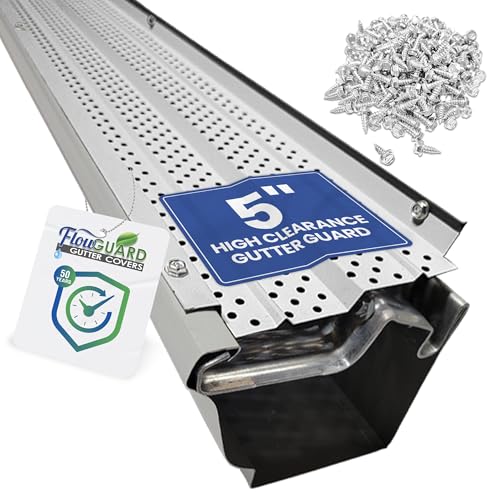
FlexxPoint FlowGuard High Clearance 5″ System 204 Ft

WATERLOCK Micromesh Gutter Guards 5″ 100 Ft White

VEVOR 6″ Aluminum Gutter Guard Heavy-Duty 52 Ft

Cuguords 60 Ft Snap-In Micro Mesh Gutter Guard (20 Pack)

Cuguords 120 Ft Snap-In Micro Mesh Gutter Guard (40 Pack)

Cuguords 210 Ft Mesh Gutter Guards Bulk Pack (70 Pack)
Taking A Closer Look At The Options
If your home has a long stretch of gutter to cover, a single 200-foot roll means fewer seams and far less fiddling with mid-span joints. The mill-finish aluminum reads as a clean silver from the curb, and the perforated pattern is engineered to shed leaves while letting heavy rain pass through to the downspout.
The system mounts under your existing shingle edge and works with the hidden hangers most modern installs already use, so you usually avoid pulling fasteners. For most two-story homes with a generous roofline, one roll is enough to finish the job in a single afternoon.
The Upside
- One continuous 200-foot run minimizes joints where debris can catch
- Compatible with hidden hangers and traditional spike-and-ferrule systems alike
- Aluminum body won’t rust, so spring melt-off won’t stain your fascia
- Low-profile mill finish sits nearly flush with the gutter lip
- Pre-perforated pattern handles typical downpour volume in most climates
Things To Consider
- Mill finish can dull over years of UV exposure if you wanted a crisp painted look
- You’ll likely need a partner to feed the long roll up a tall ladder safely
Key Specs
Who It Suits Best
Homeowners with a long roofline who want one roll to cover the whole house without seams.
Where Another Pick Suits Better
Shoppers who want a painted color match should consider the FlexxPoint FlowGuard 5″ System, which comes in white, brown, and matte finishes.
Compared to the 200-foot version, this 100-foot roll from the same A-M line gives a smaller home exactly what it needs without forcing you to wrestle an oversized coil off the ladder. The perforation pattern and mill-finish aluminum construction stay identical, so you trade length for nothing else in terms of debris handling.
For a single-story ranch or a small two-story home, this size lands in the sweet spot: short enough to handle solo, long enough to cover one side without splicing. You get the same hidden-hanger compatibility as its bigger sibling.
A Strong Showing
- Manageable 100 ft roll is friendly for one-person installs
- Identical aluminum build as the 200 ft model, just shorter
- Drops into K-style and spike-and-ferrule systems without re-fitting
Worth Noting
- You’ll still end up with a mid-span seam on longer rooflines
- Mill finish shows weathering more visibly than painted options
- Single-story homes are a better fit than tall multi-story projects
The Right Fit
Single-story or modest two-story homes with roughly 100 linear feet of gutter who want a tidy one-roll install.
Swap It Out When
Anyone tackling a long, uninterrupted gutter run should step up to the A-M Gutter Guard 5″ x 200 Ft roll instead.
This is the heaviest hitter in the roundup for raw material thickness: the painted aluminum body is built to take decades of freeze-thaw cycles without rusting. Unlike the mill-finish A-M rolls, FlowGuard ships in white, brown, matte aluminum, and thermal-thaw black, so you can match the trim rather than living with a metallic silver strip along the roofline.
Hemmed edges along the front and back double the metal where it matters most, near the mounting screws. For homes in the snow belt or coastal storm zones, that extra beef shows up where thinner guards tend to bow.
Strong Points
- Heavy-gauge aluminum stands up to snow loads and ladder pressure
- Color options mean a cleaner visual match to the trim
- Reinforced front and rear hems prevent sagging at the mounting line
Trade Offs
- Heavier panels require careful ladder handling during install
- Color matched paint can chalk in direct sun over many years
Feature Snapshot
Made For
Homeowners in snow, ice, or coastal storm regions who want a painted guard that visually blends with the trim.
Not Your Match When
Shoppers who need to clear tall hidden brackets should look at the FlexxPoint FlowGuard High Clearance version instead.
Before you commit 200 feet of aluminum to a system you’ve never held in your hand, the A-M sample pack lets you test-fit a 7-inch section on a real piece of gutter. You can flex it, snap it under the shingle edge, and check how it sits with your existing hangers, all without pulling out the full roll.
It’s the cheapest entry point on this list, and the metal itself is the same industrial-grade aluminum you’ll get in the longer rolls. For first-time installers, that hands-on preview is worth more than another spec sheet.
Notable Gains
- Hands-on test piece lets you confirm fit before buying the full roll
- Same heavy-gauge aluminum as the full-size A-M lineup
- Works with hidden and K-style hangers, mirroring the full rolls
Points To Keep In Mind
- Only 7 inches long, so it covers nothing on its own
Best Suited To
First-time buyers who want to feel the material and confirm the fit before committing to a full roll.
Look Elsewhere When
Once you’ve confirmed the fit, anyone ready to install should move up to the A-M Gutter Guard 5″ x 100 Ft roll for actual coverage.
Standard guards can bottom out on top of bulky hidden-hanger brackets, leaving a gap where debris sneaks underneath. The High Clearance version lifts the guard profile so it clears those tall brackets, which matters on homes where the original installer used a chunky hanger style. You get the same heavy-gauge painted aluminum as the standard FlowGuard, just raised up.
At 204 feet, this roll handles a generous whole-home install in a single continuous run. The included stainless steel zip screws make it easy to lock the panels down at the mounting line.
Good Reasons To Consider
- Extra clearance clears bulky hidden-hanger brackets without leaving debris gaps
- 204-foot length covers large homes without mid-span seams
- Stainless screws included, so you don’t need to source fasteners separately
- Painted aluminum body resists rust and weather fade
A Few Limitations
- Raised profile is slightly more visible from the curb than flat guards
- Heavier gauge makes solo installs at peak height a workout
Feature Rundown
Perfect Match For
Homes fitted with tall hidden-hanger brackets that would otherwise block a flat guard from seating properly.
Reach For A Different Pick When
Anyone with low-profile hangers who wants the cleanest curb appearance should consider the standard FlexxPoint FlowGuard 5″ 50-Year System.
If pine needles, shingle grit, and maple seeds are your main headache, a standard perforated guard still leaves openings large enough for those to slip through. WATERLOCK’s stainless steel micromesh tightens the pattern down to the level where those tiny offenders get filtered out before they ever reach the trough.
The painted aluminum frame under the mesh is built heavy at 0.027 gauge, which is thicker than most DIY guards on this list. For wooded lots with mixed debris, that finer filtration is what separates a clean spring from another round of gutter scooping.
Bright Spots
- Stainless micromesh stops pine needles and shingle grit that slip through larger perforations
- Heavy 0.027 painted aluminum frame resists bending under snow load
- White finish blends with most trim styles without standing out
Honest Caveats
- Fine mesh can collect pollen and needs an occasional rinse from a hose
- Heavier frame means more effort hoisting panels up tall ladders
Who Will Love This
Homeowners under pine or maple trees who struggle with fine debris that overwhelms standard perforated guards.
A Better Fit Elsewhere
Anyone with mostly large-leaf trees and minimal fine debris will find the A-M Gutter Guard 5″ x 100 Ft simpler to maintain.
Most guards on the market target the standard 5-inch K-style gutter, but homes with oversized 6-inch troughs need a wider guard to actually cover the opening. VEVOR’s heavy-duty 6-inch panel solves that exact mismatch, and at 0.02-inch aluminum thickness it leans toward the rugged end of the DIY market.
The 4 mm micro holes are small enough to keep out most debris while still handling heavy downpour. Mounting screws ship in the box, so you’re not running to the hardware store mid-project.
Points In Its Favor
- Built specifically for 6-inch oversized gutters that 5-inch guards won’t cover
- Thick aluminum alloy resists deformation under snow or ladder pressure
- Mounting screws included for a complete out-of-box install
Small Caveats
- 52-foot length is shorter than most rolls, so larger projects need multiple packs
- Mill finish leaves a visible silver strip if your trim is painted
- Won’t fit standard 5-inch K-style systems
The Right Fit
Homeowners with 6-inch oversized gutters who need a guard actually sized to cover the wider opening.
Not Your Match When
Anyone with standard 5-inch K-style gutters should choose the A-M Gutter Guard 5″ x 100 Ft roll instead.
For a quick weekend project where you don’t want to dig out the drill, the snap-in interlocking design lets you press these panels into place without a single screw. The black-coated steel micro mesh blends into the roofline visually, and the 4, 5, and 6-inch K-style compatibility covers nearly any residential setup.
The 20-pack runs 60 feet total, which works for short gutter runs or targeted trouble spots where you’ve been cleaning out the same corner every fall.
What It Does Well
- Snap-in install requires no screws or drilling, ideal for renters
- Black coated steel nearly disappears against dark rooflines
- Fits 4, 5, and 6-inch K-style gutters without separate SKUs
Practical Considerations
- Snap-in retention can loosen over years as the panels flex in freeze-thaw cycles
- Smaller mesh holes collect pollen and need an occasional rinse
Technical Highlights
Who Should Grab It
Renters or homeowners wanting a no-tool weekend project for short runs and trouble spots.
Skip It When
Anyone covering a long whole-home run should step up to the Cuguords 120 Ft (40 Pack) version for fewer seams.
The 40-pack doubles the coverage of the smaller Cuguords bundle, hitting 120 feet of snap-in mesh without forcing you into contractor-sized quantities. You get the same black-coated steel mesh and universal K-style compatibility, just with enough panels to handle a whole modest home.
Since the panels interlock, you can stop the run wherever the gutter ends without wasting material. For DIYers covering more than a corner or two, this is the more sensible middle step in the Cuguords lineup.
Reasons It Performs
- 120 ft covers most modest homes without the bulk-buy leap
- Snap-in install stays accessible for solo DIYers
- Black finish disappears against most rooflines
- Universal fit across 4, 5, and 6-inch K-style systems
Possible Compromises
- Many seam lines between panels compared to a continuous roll
- Micro mesh still collects fine pollen over a season
Built With In Mind
Solo DIYers covering a modest whole-home run who want snap-in convenience without committing to contractor-sized bulk.
Consider Something Else When
Anyone buying for a multi-property project or rental portfolio should consider the Cuguords 210 Ft (70 Pack) bulk bundle.
At 210 feet spread across 70 interlocking panels, this bulk bundle is the right size for crews working multiple properties or homeowners with a sprawling roofline. The same universal K-style fit carries over from the smaller packs, so you don’t need to inventory different SKUs on the truck.
The black-coated steel mesh installs without tools, which keeps labor time low on big jobs. For property managers and contractors, that combination of volume and speed is what makes the difference between a one-day project and a long weekend.
Why It Works Well
- 210-foot bulk bundle suits multi-property or contractor-scale projects
- Snap-in panels keep install labor low on big jobs
- Black steel mesh matches dark rooflines across most styles
Some Limits To Know
- Bulk quantity is overkill for a single small home
- More interlocked seams than a single continuous roll would produce
Whose Shelf It Belongs On
Property managers, contractors, and homeowners with large or multi-building rooflines who can use the volume.
A Better Fit Elsewhere
A single-home DIYer covering one modest property will be happier with the Cuguords 120 Ft (40 Pack) bundle.
What Matters Most Before Choosing Gutter Guard Systems
Gutter Size And Hanger Profile
The most common residential setup is 5-inch K-style aluminum, but plenty of homes run 6-inch oversized troughs or use tall hidden hangers that eat into the guard’s clearance. Measure the gutter opening at the widest point and check how far your hangers protrude above the lip before buying. The wrong width either won’t seat properly or leaves a debris gap where the guard lifts over the bracket.
Debris Type In Your Area
Different trees create different headaches. Large-leaf maples and oaks shed debris that any perforated guard handles fine. Pine needles, maple seeds, and shingle grit demand a finer mesh like the WATERLOCK micromesh. Picking a guard designed for your dominant debris saves you from discovering the gap the first time a storm rolls through.
Material And Mounting Style
Aluminum dominates the DIY market because it stays light for ladder work and won’t rust. Coated steel panels like the Cuguords packs are heavier but hold paint longer. Mounting style matters too: screw-down systems feel more permanent, while snap-in panels trade some retention for faster install. For tall two-story work, lighter aluminum with screws is usually the safer solo choice.
Length, Color, And Long-Term Maintenance
Roll length affects how many seams you’ll have along the run, and seams are where debris tends to catch first. Painted guards blend visually with the trim; mill finish reads as a silver strip from the curb. Whichever you pick, plan to inspect the guards once or twice a year to clear rooftop grit that collects on top of even the best filtration.
Key Considerations Across These Picks
Pitfalls Shoppers Hit
The most common mistake is buying a 5-inch guard for a 6-inch gutter and wondering why leaves still wash into the trough. Measure twice, especially the opening width at the widest point. Another trap is picking a snap-in panel for a tall two-story run; the retention rarely holds through multiple freeze-thaw cycles at peak height, so screw-down guards earn their place up high.
What Separates Premium From Basic
The jump from a budget snap-in pack to a heavy-gauge painted aluminum roll usually buys three things: thicker metal that resists bowing under snow, hemmed edges that reinforce the mounting line, and a finish that blends with the trim rather than standing out. For most suburban homes with normal debris loads, mid-tier painted aluminum hits the sweet spot between cost and longevity.
Frequently Asked Questions
How do I know what size gutter guard I need?
Measure the opening across the top of your existing gutter at the widest point. Most residential K-style systems run 5 inches, but homes with oversized troughs run 6 inches, which require a wider guard like the VEVOR 6-inch panel.
Can I install gutter guards without removing the gutters?
Yes, every guard in this roundup installs with the gutters still in place. Snap-in panels press into the lip without tools, while screw-down aluminum rolls slide under the shingle edge and fasten to the front lip of the gutter.
Do gutter guards work for pine needles?
Standard perforated aluminum lets pine needles slip through, but fine micromesh like the WATERLOCK stainless steel guard filters them out. Homes under pines benefit from the tighter weave, even if it means occasional pollen rinsing.
How often should I clean gutter guards?
Even the best guards need a visual check once or twice a year. Fine mesh types collect rooftop grit that should be brushed or hosed off, while larger perforated guards usually only need attention after a heavy storm drops a thick leaf load.
Will gutter guards handle heavy rain?
Most perforated and micromesh designs handle typical downpours fine, but in regions with extreme cloudbursts, look for guards with raised profiles or higher perforation density. Flat guards can overshoot the gutter in the hardest rain if the angle isn’t tuned.
The Takeaway
The right guard depends less on the product itself and more on your gutter size, your hanger style, and the kind of debris your roofline collects. Measure first, match the guard width to your trough, and pick the mesh tightness based on whether you’re battling oak leaves or pine needles. A well-matched guard system cuts your annual ladder time from hours to minutes, and that’s the real return on the install.
